
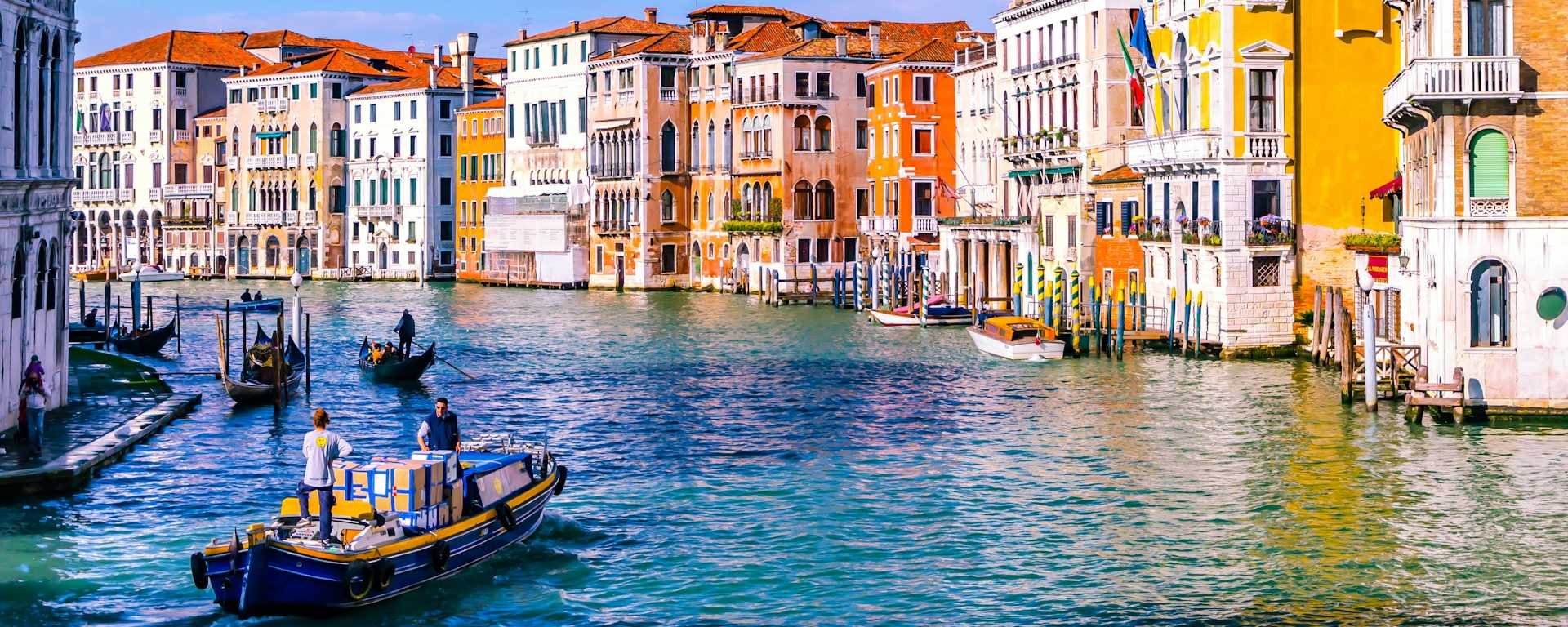
It’s hard to sum up Italy in a single itinerary. The country lends itself better to a series of discovery tours, each revealing a different way of travelling: through the cultural capitals, by the shores, by the water of the lakes or by the mountains.

Italy: one country, many geographies
Italy is best understood as a framed peninsula. To the north, the Alpine arc closes the horizon and creates a clear threshold, before opening onto the great Po plain and the foothills where water and rock create unique landscapes.
Further south, the Apennine mountain range stretches the relief, multiplying the micro-regions and explaining why two neighbouring territories can offer radically different atmospheres. In addition to mainland Italy, there are the Ligurian, Tyrrhenian and Adriatic seaboards and the islands, all of which shift the focus of the journey.
This diversity is not just decoration; it shapes the way you visit. Italy’s major cities lend themselves to dense, sometimes dizzying visits, with history around every corner. The regions, on the other hand, impose a more territorial rhythm: you move from viewpoint to viewpoint, from village to historic site, along a route that tells as much as the destination.
That’s why the most successful itineraries often combine a key city with its surroundings: Venice and its lagoon, Florence and the hills of Tuscany, Naples and its volcanic amphitheatre. Italy is not just a collection of must-sees: it’s a country where contrasts shape the story.
The invitations to travel that follow offer a simple and practical approach: geographical and tourist areas, identifiable enough to guide an initial choice, but open enough to leave room for the detours of a tour of Italy.
Rome and the Bay of Naples tell the story of ancient, baroque and volcanic Italy. Venice invites you to understand a city through its archipelago. Tuscany unfolds a classic that never runs out: art, rival cities, country roads and wine. The Ligurian Riviera showcases a steep coastline where Italy becomes a coastline and a postcard. The lakes of the north offer an Italy of holidays, water and gardens, complemented by an urban stopover like Verona. Finally, the Dolomites offer a vertical, alpine Italy, almost unexpected for those who associate the country with its squares and basilicas.
Rome-Naples: ancient, baroque, volcanic
Between Rome and the Bay of Naples, Italy condenses its history into a corridor of a few hundred kilometres. The temptation is great to line up the sites like ticking off a list: a vestige, a basilica, a square, then the sea.
Yet the journey is best told in a different way, as a passage of layers. Rome superimposes the centuries and imposes an in-depth reading. Campania, on the other hand, puts history out in the open, in a more brutal relationship with the relief and the volcano. Between the two, a number of stages serve as hinges: Tivoli for the culture of the garden, Caserta for the royal scale, then Naples for urban energy, before the satellites, Pompeii, Pozzuoli, Procida and Amalfi, which make up an archipelago of places to discover.

Rome, city of the world
Rome is often described as an open-air museum, but this formula masks what makes it unique: the city is an accumulation. Antiquity is massive, present and sometimes intrusive, in remains that require no imagination.
The Colosseum, the Forum, the arches and columns are not just monuments; they are urban landmarks that still give structure to our journeys. You can cross Rome following these traces, just as you would follow a ridge line.
This ancient Rome is matched by a Baroque Rome, whose thread is less that of imperial power than that of staging. Squares, fountains, staircases and perspectives form a different dramaturgy: the city is viewed and explored in composition. The Trevi Fountain, the Pantheon and the squares that punctuate the strolls become natural stages in a more contemporary narrative of heritage: that of the crowd, of the photograph, of the gesture of the traveller who stops, goes back, gets lost, finds the thread of his visit again.
Finally, the Vatican introduces a shift in sovereignty. St Peter’s Square, the basilica, the museums and the major basilicas shift the focus from political history to religious and artistic history, which is just as central to Rome’s identity.
In the course of a single visit, we move from an empire to a spiritual city. This juxtaposition sums up an Italy where heritage is omnipresent.
Tivoli, a breath of fresh air
To the east of Rome, Tivoli plays a role that many travellers underestimate: it’s a change of register. The Villa d’Este and its gardens offer a view through water and perspective. Where Rome impresses with its accumulation, Tivoli seduces with its organisation and the art of composing a landscape. It’s also a simple reminder that Italy is not just a land of stone, it’s a land of gardens. This interlude makes Naples more legible: it prepares the eye for what’s to come, for the way in which the area is staged.
Caserta, the royal ladder
Further south, the palace of Caserta introduces an Italy of monarchic excess. It’s not a question of making a diversion to add a site; it’s a question of understanding that Italy was not just a mosaic of city-states or ancient empires.
The palace, its grounds and its sheer size tell the story of a different period, a different kind of power. Caserta also has a geographical role in the itinerary: it marks the entrance to a Campania where human and urban density is felt, where the roads are full of traffic, and where Naples is being approached.
Naples, a city on the move
Naples is often reduced to a few clichés: pizza, football and a form of Mediterranean chaos. In reality, Naples is a key to understanding the city. It’s the place where you realise that Southern Italy is not “a simpler version” of Northern Italy: it’s a different rhythm, a different intensity. The squares, the castles, the views over the gulf, the narrow streets and the vitality of the city centre produce a direct urban experience, sometimes demanding, rarely neutral. Naples is not a setting; it is a presence for all the senses.
From a cultural point of view, Naples also acts as an archive. The archaeological museum, in particular, helps to link the region’s ancient sites to a wider context: here, archaeology is not a distant field, it’s part of everyday tourism.
Pompeii, the frozen memory
Pompeii offers a different kind of emotion: that of a city at a standstill. The eruption of Mount Vesuvius in 79 created a historic event, but also a unique visiting situation. You’re not just visiting ruins; you’re visiting a city, with its streets, houses and public spaces.
The strength of the site lies in the impression of preserved urbanism, in its proximity to an ancient life whose traces are sometimes very tangible. Pompeii transforms antiquity into a spatial experience: you walk through an urban organisation, you measure distances, you understand the fabric of a city that is open to discovery.
Pozzuoli, the archipelago and the bay
Around Naples, Pozzuoli introduces a geological and historical perspective. Built on a volcano, it is a reminder that the Bay of Naples is an unstable, living landscape, where land and sea are in constant negotiation. Ancient remains stand side by side with the story of volcanism. This superimposition is typically Campanian: the ruins are not just remains, they are sometimes witnesses to a territory in transformation.
Procida, the smallest island in the bay, offers the opposite: a smaller scale, an island atmosphere, narrow streets and a slower pace. It serves as a counterpoint to Naples, as if the journey needed a little distance. The island also makes it possible to tell the story of the bay as a whole: Naples is not an isolated city, it’s a centre around which an island world revolves.
Amalfi, the coast in relief
The Amalfi coast, with Amalfi as its landmark, is a lesson in topography. Cliffs, villages set against the mountains, cornice roads: here, the geography is visible. The tourist attraction comes not just from the sites, but also from the links between them: the way the road opens out into the sea, the way the villages hang on to the relief.
All in all, Rome and Naples make up an itinerary of rare density. It takes time, but in return it offers a complete narrative: Antiquity as a foundation, the Baroque as a setting, then the volcano as a reminder that Italy is not just a museum, but an active territory.

Venice and the lagoon: the city, then the archipelago
Venice is an anomaly to visit. A city without cars, structured by water, imposes a different tempo. You get around on foot, by boat, accepting the diversions as a principle. What can confuse hurried travellers becomes an asset: Venice forces you to slow down, to look, to listen. The city is not only beautiful; it is built to be traversed like a labyrinth.
But Venice really comes into its own when you put it in the lagoon. A common mistake is to regard the islands as peripheral excursions. In reality, they are part of the story. They explain how Venice lived, worked and produced, and how it continues to exist beyond the tourist routes.
The centre: Saint Marc and the idea of power
Piazza San Marco encapsulates the image of the Serenissima: basilica, bell tower, Doge’s Palace, facades that speak of faith, power and maritime openness. It’s an urban scene that shows that Venice was not just a beautiful city, but also a political and commercial power. The Doge’s Palace, with its ceremonial rooms, is a reminder that the city long functioned as a structured republic, with its own codes, rituals and diplomacy.
The Bridge of Sighs, often mentioned, functions here as a symbol of the other side of the story. Without overdramatising, it can be used as a narrative point: Venice is not just a souvenir photo, it also has a history of order, control and justice. It’s a city where aesthetics and politics are intimately linked.
Strolling around: the Venetian experience
Venice lends itself to itineraries for both sight and sound. Follow a canal, cross a bridge, enter a campo and emerge onto a perspective. Churches, palaces, Byzantine, Renaissance and Baroque facades create a visual continuity. Here, a visit isn’t just about museums: it’s about atmosphere. The traveller becomes a walker who composes his own map.
The season also changes the experience. In winter, the idea of carnival appears to be a way of giving the city a theatrical dimension. In summer, the Lido embodies the other Venice, that of the beaches, the sand and the Adriatic coastline. This duality shows that Venice is not just a historic centre: it is a wider territory, with a direct relationship to the sea.
Murano: working with glass
Murano, famous for its glassworks, introduces a material narrative. In a destination saturated with images, glass takes us back to the hand, the gesture, the fire, the workshop. It’s a good antidote to a purely contemplative visit.
Murano is also a reminder of the obvious: Venice has lived and breathed production and expertise, not just ceremonies and palaces.
Burano: colour and everyday life
Burano, a fishermen’s island renowned for its multicoloured houses and lace, extends the visit to a simpler Venice. The façades become a story of daily life, visual landmarks and local identity.
Burano is often photogenic; the point is to go beyond the image to tell the story of what colour does to a place: it makes it habitable, recognisable, almost familiar.
Torcello: historical depth
Torcello allows you to take a step sideways. The island is often referred to as one of the first inhabited in the lagoon and boasts a cathedral famous for its Byzantine mosaics. The visit becomes quieter and slower, taking Venice back to an earlier time.
Torcello serves as a reminder of a simple idea: the city is not born ready-made, it is the result of a lagoon territory that has been inhabited, transformed and organised.
Further afield: Padua, Vicenza, Brenta Riviera
For those wishing to broaden their horizons, the Veneto region offers logical escapes: Padua, Vicenza, the Brenta Riviera. They provide an artistic and architectural backdrop, and prevent Venice from overwhelming everything else. These names can be seen as suggestions for extensions: a way of saying that Venice is a regional capital, not an isolated cultural island.

Tuscany: Renaissance, hills and rival cities
Tuscany remains one of Italy’s most stable classics, precisely because it offers a rare balance. The towns are dense, legible and rich in art. The landscapes are immediately recognisable: hills, cypress trees, pines, olive groves and vineyards.
The journey moves effortlessly between heritage and countryside, museum and back road. This ease should not be confused with a simple destination. Tuscany is a region of character, shaped by cities that have long clashed, by urban and agricultural economies, by a history of power as much as a history of beauty.
Florence, the beating heart
Florence stands out as a centre. The history of the Medici family, the Renaissance and the place of art and architecture all converge here. The cathedral of Santa Maria del Fiore, Brunelleschi’s dome, Giotto’s campanile and the baptistery form a whole that anchors the city. The surrounding area is easy to explore: Piazza della Signoria, Palazzo Vecchio, museums, the banks of the Arno and the Ponte Vecchio. The risk in Florence is of wanting to see “everything”. The most pleasant approach is to pick out a few key points and accept the rest as an atmosphere: the market, the narrow streets, the views over the Arno.
Florence also functions as a threshold city: it opens up towards the hills, the wine routes and the villages. Even without leaving the city, you feel that the countryside is close by. This proximity is one of the hallmarks of Tuscany.
Siena, medieval Italy in tension
Siena is a different story. More compact, more mineral, more medieval in its design, it is built around the Piazza del Campo and the Duomo. The city retains the idea of a city “organised into districts”, with its traditions, its famous Palio and its rivalries. In an article, Siena is useful for describing Tuscany as a collection of towns that are not alike. We move from a luminous Renaissance to a tighter, rougher Middle Ages.
San Gimignano, silhouette and panorama
San Gimignano, with its medieval towers and World Heritage listing, is a stopover often associated with the image of postcard Tuscany. But it deserves more than a photo stop. San Gimignano speaks of a vertical Tuscany, of an architecture that marked power through height, and of a relationship with the landscape: from the heights, the hills become an inland sea.
Pisa, beyond the tower
Pisa has an immediate appeal: the Leaning Tower, the Piazza dei Miracoli, the Cathedral, the Baptistery. But here again, the point is to place the image in a historical context. Pisa was once a maritime republic. The monumental ensemble tells of a past power, an ambition, a relationship with the sea and trade. Pisa serves to broaden Tuscany: the region is not just Florence and the interior, it also has a more open, more maritime, more political side.
Lucca, elegance behind the walls
Lucca is often a surprise. Surrounded by ramparts, the city lends itself to a quieter, more leisurely visit. It’s a less spectacular Tuscany, but one that’s more habitable: there’s talk of enclosures, squares, shade and cycling on the ramparts. It’s a good stop-off point at the end of a tour, a way of saying that there’s more to Tuscany than its icons.
Chianti, terroir as landscape
Chianti, evoked as a wine reference, is not just a tasting; it’s a way of telling the story of the countryside. Vineyards, cypress-lined roads, farmhouses, hills: Tuscany is all about agricultural continuity. After the masterpieces, it’s a reminder that the region is also an economy, a way of life, a worked landscape.
Tuscany is a region that holds its own thanks to its balance. It appeals to art lovers and travellers looking for a less urban pace. It offers dense days and slower afternoons, when the landscape takes centre stage.

Ligurian Riviera: Genoa, Cinque Terre, Portofino
The Ligurian Riviera has one immediate advantage: it’s easy to understand at first glance. A steep coastline, close-knit villages, colourful landscapes and a sea that imposes its presence. But it also has a complexity: it’s a coastline where space is at a premium, where roads and railways compete for the smallest corridor, where access determines the experience. This constraint partly explains its charm: the coast has not been flattened by urbanisation, it retains breaks, promontories and thresholds.
The Genoa-Cinque Terre-Portofino itinerary offers a complete story: a major port city, a series of emblematic coastal villages, then an elegant seaside resort that showcases another, more codified Italy.
Genoa, the city-port
Genoa is a gateway to maritime history. A powerful city facing the Mediterranean, it has a vast and dense historic centre. You can tell its story from its palaces, from Via Garibaldi, from Piazza De Ferrari, which marks a junction between different urban layers. Genoa is not just a prelude to the Cinque Terre, it’s a city that deserves to be read for itself, if only to understand how Liguria has lived from trade, navigation and exchange.
Genoa also serves to anchor the route, reminding us that the Riviera is not a series of out-of-the-way villages, but a connected, inhabited, active territory.
La Spezia and the passage
La Spezia is often seen as a practical threshold. It’s the place where you change logic, where you leave the scale of the big city to enter the fragmented coastline of the Cinque Terre. La Spezia is the place to talk about mobility: here, trains, boats and footpaths are just as important as roads. The choice of means of transport influences the visit, the pace and the viewpoints.
Cinque Terre: five villages, one geography
The Cinque Terre – Monterosso al Mare, Vernazza, Corniglia, Manarola and Riomaggiore – form an ensemble whose strength lies in its geographical coherence. The villages seem to cling to the relief, nestling in coves, lined up along a coastline where the land falls into the sea. The attraction comes from the whole, not from a single point.
You can visit one village after another, but you can also choose to explore one or two in greater depth, taking the time to sit down, walk around and observe. Narrow streets, staircases, viewpoints that have to be earned. Beauty is not just aesthetic; it is linked to effort, to constraint, to the fact that the place is not easy to approach.
Monterosso, an exceptional seaside resort
Monterosso stands out for having a more accessible beach and a more pronounced seaside feel. This singularity allows us to introduce a nuance: the Cinque Terre is not a uniform block. As you pass through the village, the experience shifts towards swimming, hiking, photography and contemplation.
Portovenere, the promontory
Portovenere, with its church of San Pietro on a promontory, gives a different image of the coast: more mineral, more vertical, more dramatic. It’s an interesting stop-off point to talk about the relationship between architecture and landscape, with the stone, the rocky outcrop and the horizon.
Portovenere can also serve as a point of balance between the villages of the Cinque Terre and the more mundane Riviera; it’s a place that retains a strong visual density without tipping over into the idea of a holiday resort.
Rapallo and Portofino, the codified Riviera
Portofino, often described as a posh resort, embodies a staged Riviera. A port, a piazzetta, painted facades, a certain idea of seaside luxury. Rapallo can be seen as an intermediate stopover. Portofino provides a contrast to continue the journey. After a constrained and sometimes harsh coastline, here is a gentler Italy, where beauty is consumed in a different way, in a change of atmosphere.

Italian lakes & Verona: Italy on the water
To the north of Tuscany, between Turin, Milan and Verona, the great Italian lakes make up another Italy, one of shores, gardens and holiday resorts. Their glacial origin explains the shape of the landscapes: deep basins, indented shores, a close relief that creates constant vistas.
The journey here is by water, and that’s an expression to be taken literally. The lakes invite you to sail, to cross, to walk along, to stop in villages, to look at the mountains from a quay.
Milan, a possible door
Even if it’s just a stopover, Milan acts as a threshold. The metropolis, with its Duomo, its gallery and its urban rhythm, is a reminder that this watery Italy is backed by a major economic and cultural centre.
Milan is a good place to start: in just a few dozen kilometres, you go from a big city to a landscape of shores and gardens. This proximity is one of the surprises of Northern Italy.
Lake Maggiore: islands and gardens
Lake Maggiore lends itself to a story told through its islands. The Borromean Islands, Isola Bella and Isola Madre, are often associated with gardens and elegant resorts. It’s an aristocratic Italy, one of long stays, promenades and villas. Lake Maggiore also offers a gentle relationship with the landscape: the shores lend themselves to leisurely visits, alternating between boating, walking and taking a break.
Lake Como: elegance and architecture
Lake Como is often described as the most elegant, marked by villas and gardens. The tourist attraction lies in a form of continuity: the lake is not a single site, but a series of shores, villages and viewpoints. Bellagio, for example, is a name that often comes up as an emblematic stopover. The lake is a landscape inhabited by the history of the resort, and this history can still be read in the architecture and promenades.
Lake Garda: grandeur and plurality
Lake Garda and Lake Maggiore are cited as the largest. Lake Garda, in particular, lends itself to a wider range of uses: swimming, water sports and shore excursions.
Sirmione, on a peninsula, is often a landmark. It’s a good place to introduce the question of the seasons, where the Italian north changes dramatically depending on the month. In spring, the shores are ideal for gardens and walks. In summer, the experience becomes more seaside.
Lake Orta: discreet and bucolic
Lake Orta is described as the least well-known and perhaps the most bucolic, with the island of St Julius and its monastery. It’s a journey within a journey, a quieter, more contemplative choice. Orta prevents the story from being reduced to the big names in the media. He reminds us that Northern Italy also has its smaller, more accessible and less saturated worlds.
Verona: the urban stage that completes the picture
Verona is a natural complement: a city of art and heritage that brings urban density to an itinerary dominated by water. Where lakes offer shores and gardens, Verona brings stone, squares and the idea of a city. The combination works well, showing that Northern Italy is a place of rapid transitions, where you can change scenery without changing region.

Dolomites: vertical Italy
The Dolomites often come as a shock to travellers who associate Italy with art cities and seaside resorts. Here, the scenery is Alpine, vertical and spectacular. The peaks, mountain passes and alpine pastures make up a landscape where the eye never rests. The fact that the Dolomites are listed as a UNESCO World Heritage Site is a reminder of the massif’s natural importance, but the tourist attraction here lies not in the label, but in the experience. Travelling in the Dolomites means accepting that the route becomes an event, that the viewpoint becomes a stage, that the weather changes the story.
An Italian mountain apart
Located in the very north of Italy, the Dolomites offer a different way of travelling. You don’t come here just to see, but to cross. The logic of the itineraries is built around valleys and passes. Panoramas are omnipresent, but they are never the same: here a clear wall, there a greener valley, further on a pass that opens onto another slope, with slowness, viewpoints and variations in light.
The passes: a narrative by road
Some itineraries mention the great Dolomite route and passes such as Pordoi or Trois Croix. These names are more than just points on a map: they are shifts in the landscape. Each pass changes the orientation, the view and sometimes even the cultural atmosphere of a valley, turning the journey into a succession of thresholds.
Cortina d’Ampezzo: accessible mountains
Cortina d’Ampezzo is a showcase for the Alps. A resort and an elegant destination, it is the embodiment of a more accessible mountain, where people come for the air, the views and the walk, without necessarily looking for sporting performance. The Dolomites are not just about mountaineering. They can also be a contemplative Italy, where you can enjoy the mountain as a landscape.
Trentino-Alto Adige: Italy changes language
Passing through Trento and Bolzano introduces a more cultural element: Trentino and Alto Adige (South Tyrol) are often described as a region with German-speaking influences. The Ötzi museum in Bolzano, for example, helps to anchor this difference in a concrete visit. Italy is not homogenous: in the north, the languages, urban architecture and traditions point to a different Europe. We stay in Italy, but the country is on the move.
After Rome, Venice and Florence, the mountains are a reminder that Italy is also a land of nature, relief and cultural frontiers. It’s a different Italy, but it’s part of the same national entity.

Travelling by coach in Italy
Italian itineraries are often puzzles. Historic centres can be visited on foot, archaeological sites are sometimes on the outskirts, coastal areas require specific access, and the mountains impose their own tempo. In this context, a coach tour is a practical way of travelling that opens up the possibilities and transforms a series of stages into a continuous journey.
The first advantage is logistical. On multi-region itineraries, the coach makes it possible to link up very different places without each day becoming a transport operation: where to park, how to get around restricted traffic areas, how to manage journey times. The second advantage is that the pace is clear. A tour imposes a framework: timetables, duration, alternating guided tours and free time. This framework may suit those who want to concentrate on the content – monuments, museums, landscapes – rather than the organisation.
The format is particularly coherent for groups where the interest is based on several nearby stages: Venice and the islands of the lagoon, the northern lakes and a city like Verona, the Ligurian Riviera between Genoa, Cinque Terre and Portofino. In these cases, success depends less on a single flagship site than on a fluid sequence. The coach becomes a thread.
There are also limits, and it’s worth saying them straight out. The constrained framework: meeting points, fixed times, less freedom to linger or improvise.
Some people prefer the flexibility of independent travel, especially in regions where you want to take your time here and there – rural Tuscany, lakeside villages, mountain roads. But even here, the coach can be a good way to get your bearings, to get a feel for the area before returning to it in a different way.
Italy on a journey and on a map
And to continue the journey in geography, here’s a map of Italy with the cities and some major tourist sites: