
Electricity first appeared in homes at the beginning of the 20th century as a means of lighting, with the popular lamp*, and has now become an essential part of everyday life.
But have you ever wondered where and how it is produced and consumed in France and Europe?
Here’s a quick overview to help you understand the origin, impact and type of electricity we use every day.
The source of electricity
Fossil fuels and nuclear power
There are several possible solutions for producing electricity, with energy sources varying according to the techniques used.
Fossil fuels such as coal (25% by 2020*), gas (24%) and oil (31%) are the main sources of thermal power generation. If we add uranium-based nuclear power generation (5%), we reach a total of 85% of the world’s electricity generation from fossil and non-renewable energy sources.
In Europe, the situation is different, with a lower share of fossil fuels, at 35.7% in 2020, but a significant share of nuclear generation, at 24.4% of total electricity production.
In France, the situation is also different, with almost three-quarters of electricity generated by nuclear power plants (72.6% in 2020*) and less than 10% from fossil fuels such as oil, gas and coal (9.3%).
Renewable energies
Electricity can also be generated using renewable energy sources: solar, wind, hydro, photovoltaic or biomass.
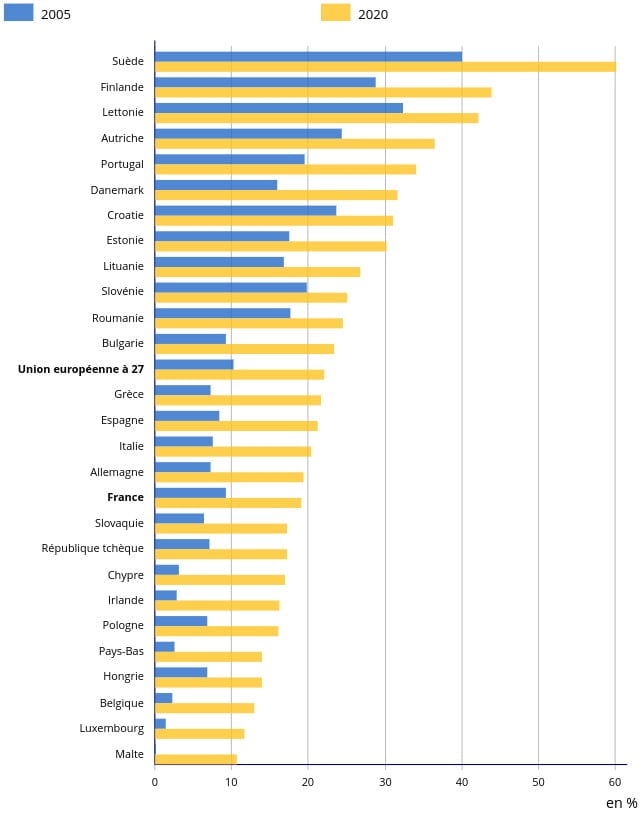
In Europe, this share has been growing steadily since the beginning of the century, with renewable energy now accounting for more than a third of gross final consumption in the European Union, although there are significant disparities between countries.
Share of renewable energy in the European Union :
Production and consumption in Europe
Production: countries and companies
In 2020, the total production of the 27 countries of the European Union was 2,786 Terawatts (TWh*), with almost 60% of this production provided by 4 countries:
Germany (20.6%), France (19.1%), Italy (10.1%) and Spain (9.5%).
On the company side, EDF, Electricité de France, is Europe’s largest producer with 594 TWh in 2012*, followed by RWE in Germany (202 TWh), Vattenfall in Sweden (194 TWh), E.ON in Germany (180), Enel in Italy (180), GDF-Suez in France (163 TWh) and Iberdrola in Spain (76 TWh).
It should be noted that in 2019, some countries such as Germany, Sweden and Spain produced more electricity than they consumed, unlike France and Italy, where consumption is higher than production.
On the nuclear side
A constant source of concern about the security of production, particularly since the disasters at Chernobyl in 1986 and Fukushima in 2011, the share of nuclear power has been falling for several years, particularly with the gradual phase-out of nuclear power in Germany, Belgium and Spain, recently slowed by the war in Ukraine and the drop in gas supplies from Russia.
Nuclear thermal generation still accounts for almosta quarter of overall generation in Europe, at 24.5% in 2020, but 66.5% in France.
What about renewable energy?
On a per capita basis, the Scandinavian countries are the main producers and consumers of renewable energy, mainly wind and hydro power, but also biofuels, which are used as a source of heating in Sweden, for example.
In terms of commitments for the share of renewable energy in the energy consumption of European countries, some countries, such as Sweden, are ahead of the targets set for 2020, while others, such as France, are clearly lagging behind:

Electricity mapping
Would you like to find out more about the subject, with more precise statistics or relevant maps to help you better understand the electricity issues in France and Europe?
Here is our selection for a hypertext journey between figures and interactive cartography:
Electricity Maps

Produced by Tomorow*, a Danish company, Electricty Maps is a map showing electricity production and consumption in Europe and a number of other countries around the world.
The map compiles both quantitative and qualitative data, indicating thecarbon intensity of kilowatt-hours for each unit produced, and the percentage of low-carbon and renewable energy electricity production.
Example of France
Mapping allows you to see the environmental impact of national production on a daily basis:

Together with the maps, the statistics provide further details on the origin of electricity generation and its impact by source:

But also on the breakdown of CO2 emissions, again by source:

Another complementary map is the consumption map, which uses the same principle as for production to identify sources of consumption and emissions.
This map also identifies import and export flows between countries.
In France, for example, the country currently imports electricity from the UK, Switzerland, Belgium, Spain and Germany, with the carbon intensity of the latter being higher than that of domestic production:

Direct access to the interactive map of electricity in Europe, Electricity Maps:

Statistics in France with RTE Eco2mix
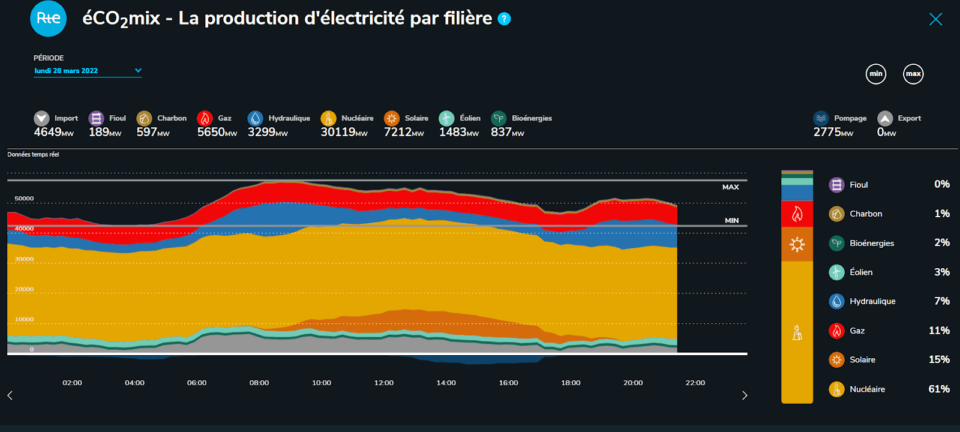
In France, THE source of figures for electricity flows is the Réseau de transport d’électricité or RTE, the national electricity grid operator.
Eco2mix is a freely accessible data visualisation tool that provides real-time access toelectricity figuresin France:
Consumption, production, cross-border trade, CO2 emissions, flows by region, key figures, monthly analyses, market and energy data…
The data is easy to consult, with the option of comparing periods, displaying details and mixing figures.
Example of the Auvergne-Rhône-Alpes region
Region by region, you can see production, consumption, compare periods and hour by hour, every detail :
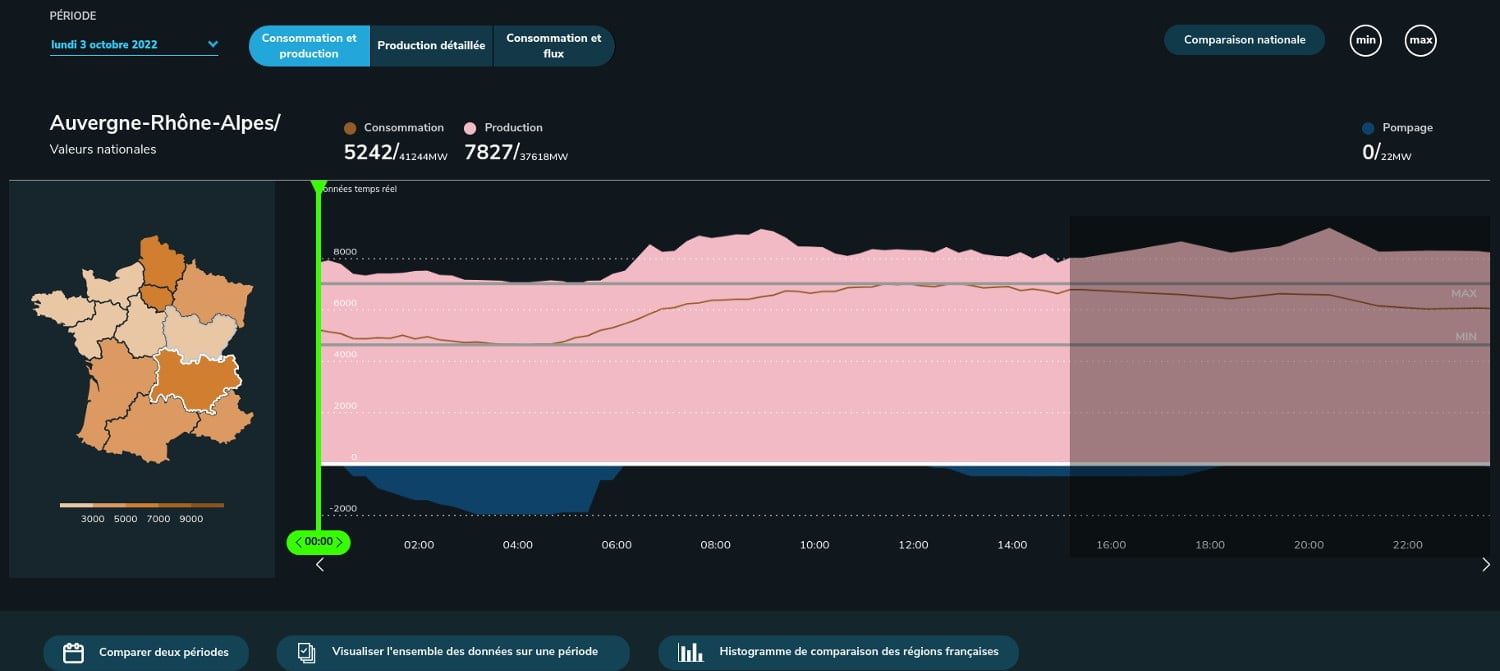
To consult the data and view production and consumption, go to the dedicated RTE France website, eco2mix:
What about nuclear power?

In addition to our article on the map of nuclear power plants in France and around the world, the interactive map on the Nuclear Monitor website shows the proportion of nuclear power generated in France and, more importantly, thestatus of the country’s nuclear fleet:
site in production, malfunctions, status of reactors, real-time capacity (production in MW).
To consult the map and find out the details of each power station in France, go to the interactive map of the nuclear monitor :
Electric tourism?
Are you passionate about the subject? Why not imagine a discovery tour through the countries of Europe to visit the most important electricity production sites?
Let’s set off on an electric, energy and tourist tour of Europe!
Geothermal power stations in Iceland
With its volcanic geology, Iceland produces over 80% of itsenergy from geothermal sources, supplemented by hydroelectric dams.
The production sites are an opportunity for industrial tourism with comfortable variations such as open-air public baths or natural sites such as volcanic geysers.

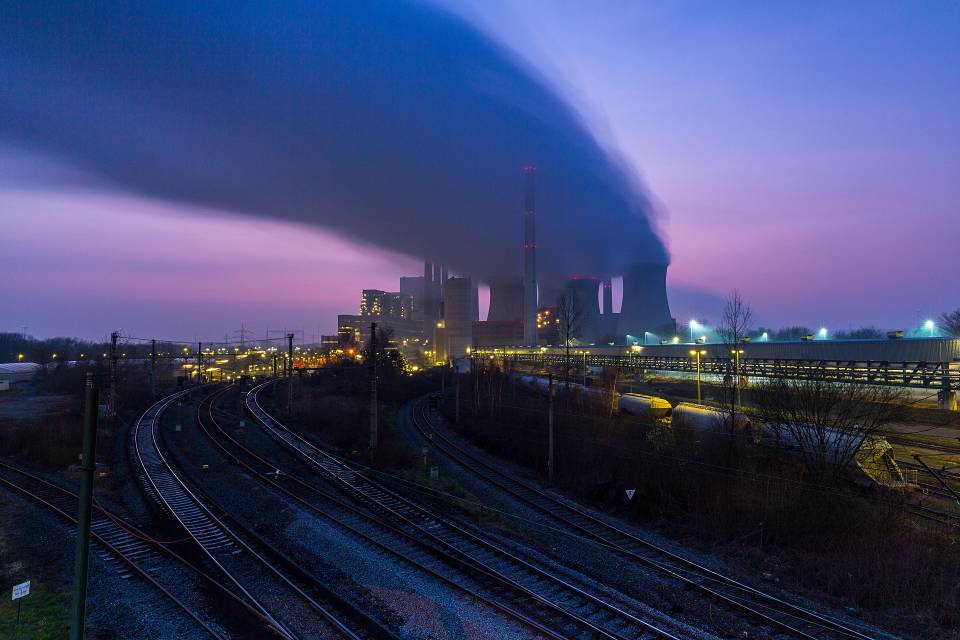
Lignite-fired power stations in Europe
Do you like industrial sites or visiting power stations? Or have you never seen a coal-fired power station?
Then this is the perfect opportunity to visitGermany, for example, with its Boxberg and Scholven power stations, or the largest and most polluting in Europe, the Bełchatów power station in Poland, a vestige of a bygone era but still active.
Nuclear power stations in the Rhône valley
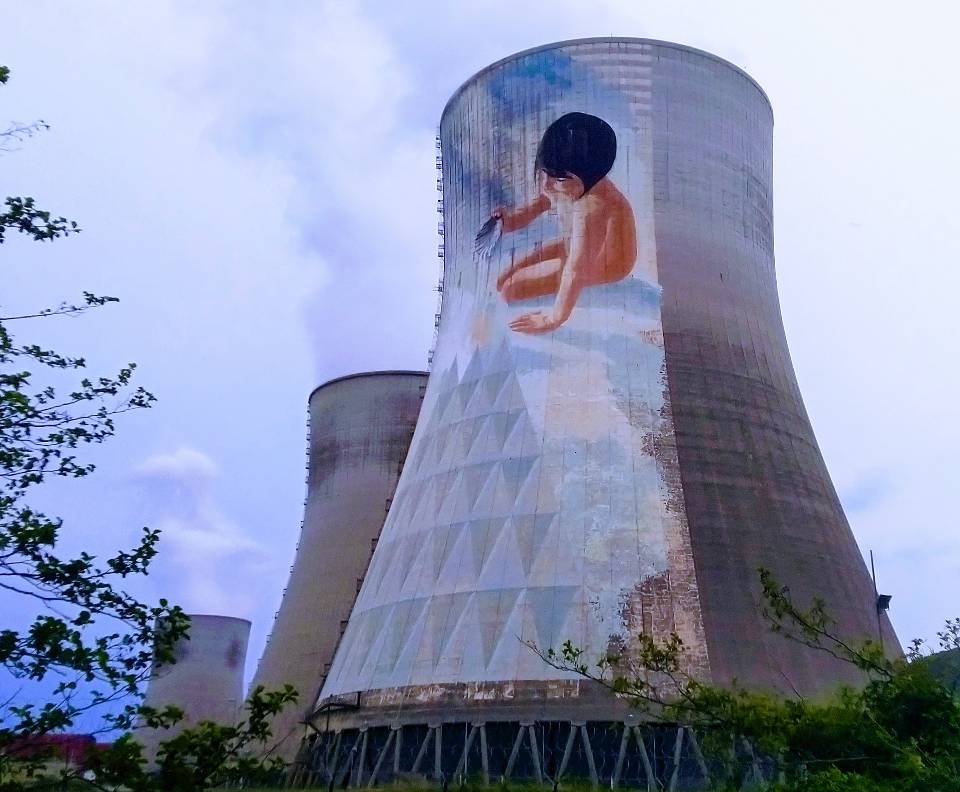
Bugey, Saint-Alban, Creys, Cruas, Tricastin… nuclear power plants dot the banks of the Rhône, each with their own specific technical features.
EDF offers tours of its generation sites for the general public or school groups, depending on the period and subject to registration.
Travel+
- Map of nuclear power plants in France
- La lampe populaire, arts and crafts library
- Energy in the European Union, All of Europe
- Electricity generation in France, Ministry
- Chronology of lighting techniques, Wikipedia
- Electricity in Europe, Wikipedia
- Energy in Iceland, Wikipedia
- Tomorrow, Dealroom
- Interactive map of rising sea levels
- Map of global warming by region
- Forest weather and fire risk in France (French)
- Going back in time with photos and maps, IGN (French)
- Vigicrues, risks and flooding (French)
- Environment, pages and articles