
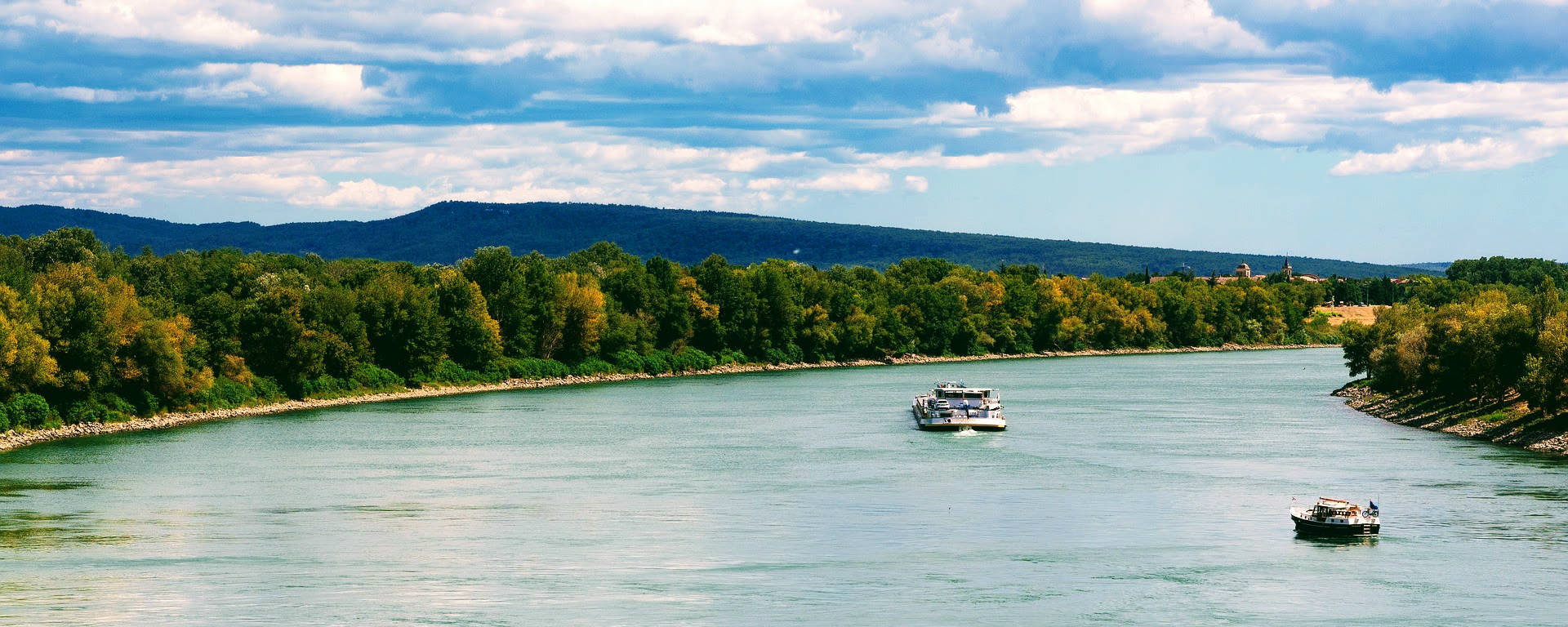
A source of life, a transport route and a living heritage, the Rhône is an exceptional river as it flows through its valley. From its birth beneath the glaciers of the Alps to the wild majesty of the Camargue, embark on a unique itinerary in the heart of Europe. From towns steeped in history to wide open natural spaces, discover how the river has always shaped territories, landscapes and heritage, inviting travellers and locals alike to explore the Rhône valley in all its vastness and diversity, each day with renewed amazement.

The Rhône Valley, Europe’s backbone
Europe’s 8th largest river in terms of average flow, the Rhône rises in the Alps in Switzerland, crosses the border into France at the mouth of the Arve, after flowing into Lake Geneva, and ends its course in the Mediterranean. It flows for almost 812 kilometres, crossing mountains, skirting thousand-year-old cities, irrigating fertile plains and feeding the wild exuberance of the Camargue.
Geographical overview, discovery of its tributaries, emblematic towns, natural areas to discover, like an invitation to navigate on one of the largest river routes in Europe, an area of history and future along the Rhône valley.
The Rhône in figures
- 812 kilometres long: 290 in Switzerland and 522 in France
- Catchment area1: 97,800 km² (including 7,800 km² in Switzerland)
- 48th largest river in the world and 8th largest in Europe, 24th longest.
- Average annual flow at Beaucaire (Gard): 1,690m3/s.
- Record flood of 2003: 11,500m3/s.
- 22 major dams and hydroelectric power stations
- 120,000 hectares of irrigated farmland
- 11 industrial port sites, more than 4,500,000 tonnes of annual traffic (2021)
- Around 1,300,000 inhabitants on the shores of Lake Geneva and the Rhône in Switzerland
- Over 1,500,000 inhabitants in France from Bugey to Camargue
The Rhône River, a common thread running through the regions
The Rhône originates at an altitude of over 2,200 metres in the St Gotthard massif, where the glacier near the Furka pass melts, giving rise to a modest torrent.
The river quickly made its way through the valleys of Switzerland, widening from Valais to Geneva via Vaud, before plunging into Lake Geneva. This vast natural aquatic reserve is both a frontier and a reservoir, bearing witness to the importance of the Rhône for Switzerland’s water resources and energy production.
At the end of Lake Geneva, Geneva emerges as the great riverside city, with its sister city Lausanne on the northern shores. An international centre par excellence, the city takes advantage of the banks of the Rhône and the lake for nautical and tourist activities, symbolising an art of living and an openness to Europe.
Soon, the river flows westwards, criss-crossed by CGN boats before the hydroelectric dams at the far end of the lake, and crosses the Franco-Swiss border to meet the Arve and its water laden with mountain alluvium.
From the Ain, it curves southwards: the French route begins, a long blue ribbon that grows in size and colour with every kilometre, weaving impetuously between the Auvergne-Rhône-Alpes, Occitanie and Provence-Alpes-Côte d’Azur regions all the way to the Mediterranean.

The main tributaries of the Rhône
Agriculture, energy, industry, transport and tourism: the whole valley is shaped by the river and irrigated by its tributaries, from the foothills of the Alps to the plains of Provence.
Over the course of its geography, the river feeds the largest natural water reserve in the Alps, Lake Geneva, with a surface area of 581 km². Further south through its canals, the Rhône is artificially extended into the Languedoc region by the canal des étangs, and reaches Sète from Beaucaire, on the way to the Canal du Midi. All along its course, it flows through towns, villages and countryside, supplying water and enriching an ecosystem that is thousands of years old.
The Rhône is not alone; it is enriched by a multitude of tributaries that structure the landscape, irrigate crops, nurture biodiversity and enrich the lives of local people. These confluences shape the geography, heritage and everyday life of the Rhône basin.
Here are the major tributaries, with their confluences and their main inputs and uses:
| Tributary | Confluence | Zoom | City, Territory |
|---|---|---|---|
| Arve | Geneva | Glacial alluvial deposits Industrial valley and mountain leisure activities | Geneva, Geneva region |
| Ain | Upstream of Lyon | Biodiversity, nature reserves and agriculture | Bugey, Isle-Crémieu |
| Saône | Lyon | River axis, shops, tertiary activities Confluence mixed-use district | Lyon, Beaujolais and Dombes |
| Isère | Pont-de-l’Isère | Agricultural irrigation, hydroelectricity, logistics Road link through the Isère valley | Grenoble, Valence and Romans-sur-Isère |
| Drôme | Loriol, Livron | Agricultural and natural areas, greenway Gravel pits and logistics | Valentinois, Crest and Diois |
| Ardèche | Pont-Saint-Esprit | Outdoor and heritage tourism, winegrowing | Gorges de l’Ardèche, Tricastin |
| Gard | Vallabrègues | Gorges du Gardon, Roman heritage | Remoulins, Beaucaire and Costières |
| Durance | Avignon | Agricultural irrigation, hydroelectricity, tourism | Cavaillon, Venaissin and Crau |
At the confluence with the Rhône and in their gorges and valleys, these tributaries and the river contribute in particular to :
- Increase the number of natural environments
Alluvial forests, gorges, agricultural plains, wetlands, all of which are refuges for flora and fauna.
- Ensuring the supply of drinking water and irrigation
Millions of inhabitants and emblematic crops, from cereals in the Drôme to orchards in Provence.
- Developing leisure activities and tourism
Swimming in the gorges, canoeing on the Ardèche, family walks or cycling along the river banks – there are plenty of opportunities for sports and nature-based leisure activities.
- Discover the culture and history
Pont du Gard, villages clinging to the cliffs, nature parks, markets, traditional festivals and much more along the rivers and confluences.
Emblematic cities, areas and spaces
Along its course, the Rhône passes through towns, villages and regions of contrasting character. Between Alpine landscapes, large dynamic cities and emblematic natural areas, each stage shapes the unique personality of the valley and bears witness to the richness of its history and geography, from Switzerland to France.
In Switzerland
The Rhône Valley begins in Switzerland, crossing the cantons of Valais, Vaud and Geneva before the border.
The Valais
The canton of Valais is the birthplace of the Rhône, which rises from the eternal snows of the Furka glacier in the heart of the Swiss Alps.
This mountainous region, renowned for its majestic peaks and deep valleys, offers a unique natural spectacle. From traditional villages such as Brig or Sion to renowned winter sports resorts, the Valais embodies a subtle harmony between intense alpine landscapes, mountain farming (terraced vineyards, orchards) and living traditions.
Here, the Rhône is an integral part of everyday life and has always shaped the region’s identity.
Vaud
The canton of Vaud accompanies the Rhône as it passes through Lake Geneva, where it occupies the northern shore.
A true crossroads between the Swiss and French shores, Vaud attracts visitors with its renowned vineyards, historic towns like Lausanne and hillsides plunging into the great lake. The Rhône is invisible in this part of the region, which is swallowed up by the waters of Lake Geneva, but it remains central: it feeds the basin, irrigates the land, and gives French-speaking Switzerland a unique gateway to Western Europe, combining heritage, a gentle lake and economic dynamism.
Geneva
In Geneva, the Rhone returns to the light as it leaves Lake Geneva to flow through Switzerland’s most cosmopolitan city. Internationally renowned for its institutions and diplomatic role, Geneva flourishes on both banks, the river and the lake: lively promenades, emblematic bridges, historic districts and an abundant cultural life are organised around this lively artery. The Rhône gives structure to the city, even giving the lake its other name, inspiring its architecture and accompanying its inhabitants in their daily lives, while marking the river’s entry on its long journey to France.

In France
The Rhône Valley in France stretches from the Arve to the Mediterranean via the crossroads of Lyon, crossing a variety of regions where historic towns, fertile plains and natural landscapes meet. Each region, with its own rich history and distinctive features, has created a living valley where the river remains at the heart of life and landscapes.
Ain
In the north-east of the Rhône route in France, the Ain département stretches from the foothills of the Jura and Bugey mountains to the rich plains of the Dombes. It shares its riverbanks with Haute-Savoir and Savoie. Here, the Rhône carves out a variety of landscapes: limestone cliffs, wetlands and alluvial meadows.
The river provides the département with some remarkable natural sites, such as the Haut-Rhône nature reserve, popular with anglers, hikers and lovers of local flora and fauna. The villages along the river benefit from its geography, while the historic bridges are a reminder of the importance of trade between the banks and neighbouring regions. The first hydroelectric dams on the French side (Génissiat, Seyssel, Anglefort, etc.) have been providing the river with energy since the last century.
Les Savoie
Although the Rhône only crosses a small part of Haute-Savoie and Savoie, it nevertheless shapes the western boundary, channelling some of the water from the Alps southwards. This proximity reinforces the connection between Alpine valleys, lakes and the Rhone plain.
Savoie’s villages have taken advantage of the region’s transport links and water resources, while preserving their typical architectural heritage of stone and wood. The river is linked to Lac du Bourget by the Canal de Savières, its outfall.
Rhône
Running through the department of the same name, the Rhône accompanies Lyon as well as many of the towns and natural sites upstream and downstream of the metropolis. Here, the river structures the valley, fertilises the plains and enhances the industrial, rural and urban heritage.
The hillsides, the southern gateway to the Beaujolais region and the banks of the river offer a mosaic of landscapes and leisure activities just a few kilometres from the centre of Lyon, with industrial and chemical activities predominating in the south, such as the Edouard Herriot port at Gerland and the Feyzin refinery, the 6th largest in France in terms of refining capacity.
Lyon Metropole
The nerve centre of the valley, Lyon, at the confluence of the Rhône and Saône rivers, embodies the richness of the entire basin. Vibrant and cosmopolitan, the city combines an exceptional architectural heritage, UNESCO-listed old quarters, renowned gastronomy and a dynamic cultural scene.
The riverbanks are the scene of markets and festivals, and are popular places to stroll and relax. The Rhône department takes its name from the river, underlining its centrality to the area, and the town has been marked by the rhythm of the river for centuries.
Isère
Running through the south-east of the country, the Isère opens briefly onto the Haut-Rhône at Anthon, and then joins it again in the middle Rhône valley at Chasse and Vienne, as far as the Drôme. The region is home to the fringes of the Monts du Lyonnais, the fertile plains of the Bièvre and the first hills of the Dauphiné.
The cradle of the passage between the Alps and the valley, the Isère also includes part of the Platière nature reserve, offering splendid views of the still wild river. Vienne, on the banks of the river, is a real heritage gem, with its ancient remains, museums and cultural events.
Vienna
On the left bank, Vienne boasts an exceptional ancient heritage: Roman theatre, the temple of Augustus, remains of the city walls and the forum. As a crossroads city, it combines its Gallo-Roman heritage with a modern way of life, enlivened by top-notch cultural events, including the famous Jazz à Vienne festival every summer, which attracts audiences from all over Europe.
Loire
The Rhône flows through the Loire department in a short but significant stretch upstream of the Lyon basin, in a narrow valley dominated by the Pilat massif.
The river winds its way between wooded ridges, villages perched on hilltops and natural areas ideal for walking. The Loire has an authentic character here, linking the river to the industrial history of Saint-Etienne and the rural countryside.
Ardèche
On the right bank of the Rhône, the Ardèche offers a striking contrast between deep gorges, limestone plateaux and steep-sided valleys. A land of hilltop villages and spectacular panoramas such as those of Saint-Joseph and the Ardèche gorges, the region is a natural magnet for outdoor enthusiasts: canoeing, cycling, climbing and swimming are all part of the summer season.
Tournon-sur-Rhône, Bourg-Saint-Andéol, Viviers and other riverside villages take advantage of the river’s proximity to organise markets, festivities and cool baths on hot summer days.
Drôme
Between the Vercors and Provence, the Drôme marks the transition to more southerly landscapes. Stretching along the left bank of the Rhône, this département offers a wide variety of areas: market-garden plains, wine-growing hillsides and the Tricastin hills. The town of Valence, gateway to Provence, is an inspiring place to stop, with the charm of its historic centre, the atmosphere of its markets and the shady Jouvet park beside the river.
Further south, small villages such as Crest and Loriol line the banks and confluence with the river of the same name, while the surrounding countryside is ideal for walking or cycling and discovering local heritage products.
Valencia
As the valley’s southern gateway, Valence welcomes visitors to its old town centre, with its narrow shopping streets, shady squares, canals and the port of l’Épervière, a stop-off point for river tourism. It’s also a great starting point for exploring the Drôme Provençale, with its colourful markets and picturesque villages.
Vaucluse
The Rhône forms a natural boundary to the west of Vaucluse, a department bathed in Provençal air. Avignon, on the riverbank with its famous singing bridge, is the centre of the papal heritage and the splendour of world theatre, particularly during its not-to-be-missed festival.
Around Avignon, the riverside villages (Villeneuve-lès-Avignon, Châteauneuf-du-Pape) benefit from a generous terroir and a history closely linked to the river in the Provence-Alpes-Côte-d’Azur (PACA) region.
Gard
Opposite the Vaucluse, in the Occitanie region, the Gard stretches its garrigues and riverbanks, combining Roman heritage, towns, villages, the city of Nîmes and Mediterranean landscapes.
The Rhône borders the ancient cities of Beaucaire and Remoulins, while its eponymous tributary, also known as the Gardon, winds its way to the prestigious Pont du Gard. The region also has its sights set on the Camargue, with its marshes, market gardening and bullfighting traditions.
Bouches-du-Rhône
The last stop before the Mediterranean, the Bouches-du-Rhône offers the grandeur of the delta’s landscapes: salt marshes, ponds, wild beaches and exceptional flora and fauna. Arles, the last great city on the river, combines sun-drenched alleyways, ancient arenas and a cultural life focused on photography and the arts.
To the south, the Camargue occupies a special place, a unique natural sanctuary where the Rhône ends its course, offering an explosion of light and biodiversity that crowns this river journey.

Natural sites and landscapes to explore
From north to south, the Rhône Valley offers a wealth of natural wonders to discover, with its many countries, confluences, varied landscapes and changing climates, just a few examples :
- Rhône Gorges (Switzerland)
Steep cliffs, craggy shores and hiking trails plunge visitors into a striking Alpine atmosphere in a Rhône that is still raw and wild, just like the future gorges of some of its tributaries. - Monts du Lyonnais and Pilat
These green hills, with their open panoramas, provide a natural breathing space for the Lyon region and are home to a flora and fauna that has remained unspoilt despite considerable human pressure. - Nature reserves
Haut-Rhône, Etang de Mépieu, Ile du Beurre and Ile de la Platière, the confluence of the Isère, Printegarde, Deux Lacs, the banks of the Durance and the Camargue are just some of the many nature reserves dotted around the Rhône valley. These are unique areas and refuges for migratory birds and alluvial vegetation, perfect for observing and relaxing in the great outdoors. - Camargue
To the south, the valley opens onto a world of its own, the Camargue, a land of ancestral development and unspoilt nature: salt marshes, immense beaches, horses, bulls and pink flamingos symbolise this regional nature park of exceptional biodiversity. - ViaRhôna
The ViaRhôna is an 800-kilometre cycle route that follows the river and links most of its sites, offering a gentle and continuous way of discovering the most beautiful landscapes on the Rhône. It has a European dimension and is an extension of the Rhône cycle route in Switzerland, linking small towns and natural areas all along the river. Each stage offers its own atmosphere, between wide open spaces and protected environments, offering travellers a gradual immersion from Lake Geneva to the Mediterranean.

Heritage and culture
The Rhône Valley boasts a wide variety of major sites and events, combining architectural heritage, living landscapes, museums and renowned cultural events. Here are just a few of the highlights, organised by theme.
Ancient monuments
- Archaeological site of the Forum de Martigny (Valais)
- Roman theatre in Lyon and temple of Augustus in Vienne
- Gallo-Roman remains and ancient arenas in Arles
- Pont du Gard (near Uzès, up the Gardon tributary)
- Remarkable abbeys, churches and chapels all along the Rhône.
Old quarters and urban heritage
- The historic centre of Sion, with its narrow streets and well-preserved medieval buildings
- Old Lyon’s cobbled streets, traboules and Renaissance façades
- The Roman city of Vienne and Saint-Romain-en-Gal
- Old quarters of Valence, canals and Jouvet Park
- Medieval streets and squares in Avignon’s historic centre
- Place des Lices and old streets in Arles
Museums and exhibitions
- Valais History Museum in Sion
- Fine Arts Museum in Lausanne and Science Museum in Geneva
- Musée des Confluences in Lyon
- Gallo-Roman museums, local history museums along the river
- Musée Réattu in Arles, Petit Palais in Avignon
Cultural events
- Festival de la Cité in Lausanne
- La Bâtie-Festival de Genève
- Festival of Lights in Lyon
- Avignon Festival dedicated to theatre
- Rencontres de la photographie in Arles
- Jazz à Vienne Festival (France) and Montreux (Switzerland)
- Markets, traditional festivals and artistic events in every town and village, depending on the season
This collection showcases the diversity of the Rhône Valley’s heritage along the river and through the seasons, from ancient sites to lively districts and major cultural events.

Human geography and mobility
The Rhône River provides a structure for human life throughout its valley, linking large towns, villages, markets and natural areas. This natural corridor facilitates exchanges and travel, both modern and traditional, whether crossing a conurbation or linking different areas by water or road.
In urban centres, the river gives rhythm to the organisation of neighbourhoods and offers a variety of modes of transport, while in rural areas it shapes the local network and maintains lively links between the two banks with the bridges and footbridges that span it.
Main means of transport in the Rhône Valley
As a central gateway for European and French traffic, the Rhône Valley offers a wide variety of means of transport that effectively connect its towns, villages and landscapes, from Switzerland to the Mediterranean. Here are the main ones:
- Road
In Switzerland: A1 motorway (Vaud), A9 (Valais), national network and cantonal roads run alongside the Rhône and Lake Geneva.
In France: motorways A7, A9, A41, A42, national roads and departmental roads border the river from near and far. - Rail
In Switzerland: CFF Vaud/Valais line (Geneva-Brigue), main stations at Sion, Martigny, Brigue, Geneva.
In France: Intercity and TGV (Paris-Lyon-Marseille) lines, regional TER trains, stations in the valley’s main towns. - River
In Switzerland: you can sail on the Lake Geneva between Geneva, Lausanne and the towns on the banks of the lake with CGN boats.
In France: commercial shipping, river cruises and tourist shuttles on the Upper Rhône, the Saône and from Lyon to Port-Saint-Louis-du-Rhône, towards Sète and the Canal du Midi. - Soft mobility
In Switzerland: cycle routes on the Route du Rhône Route, around Lake Geneva with numerous footpaths along the river.
In France: ViaRhôna, which runs from Switzerland to the Mediterranean, walks along the riverbanks in some communes, and a traditional ferry in the Camargue. - Urban transport
Geneva: trams, buses, Mouettes Genevoises (boat buses) and Compagnie Générale de Navigation (CGN) on Lake Geneva
Major French cities and départements: trams, buses, urban services, river shuttles depending on the conurbation
This transport network, which links the Alpine source to the Mediterranean shores via the main towns and natural areas, offers easy, varied and appropriate access for all types of visitor to the Rhône Valley.