

Take the ferry
A ferry is a type of vessel used to transport passengers, vehicles, and sometimes goods, from one bank of a river or lake to another, from one port to another, across seas and oceans. Ferries are a vital part of the transport infrastructure in many parts of the world, facilitating trade, tourism and the daily lives of riverside communities.
Whether it’s for day-to-day mobility in different regions of the world, a holiday to discover an island or a country, or a trip throughout the year, the ferry is an essential means of transport for our blue planet, more than 70% of which is covered by water.
Find a ferry?
By port or city, by country or company, with a comparator or by shipping line, the choice is yours:




Once upon a time, sailing
Since the dawn of civilisation, man has sought to conquer waterways for transport, trade and exploration. The first boats, simple rafts or dugout canoes carved out of tree trunks, mark the beginning of the human adventure on water. These primitive, albeit rudimentary, means of transport laid the foundations for modern passenger ships.
Ancient civilisations such as the Egyptians, Greeks and Romans not only perfected shipbuilding, but also introduced the first organised ferry services.
In ancientEgypt, for example, passenger boats were essential for crossing the Nile, a vital route for trade and communication within the empire. Similarly, in ancient Greece, boats linked the many islands to the cities of the mainland, fostering trade and the political and cultural development of the region.
Other examples of ancestral navigation are the Polynesian sailors, who sailed across the Pacific without a compass or GPS and in large canoes. Using the stars at night and the waves, clouds, birds and floating plant debris during the day, they were able to travel, trade and explore over thousands of nautical miles.
Antiquity also witnessed significant inventions in ship design, such as the introduction of the sail, which increased the speed and efficiency of sea crossings. These advances enabled ancient societies to develop extensive trade networks and forge cultural links across the seas.

The expansion of maritime transport
With the arrival of the Middle Ages, the role of river and sea navigation grew to become crucial to European transport. Crossings became more regular, fuelling trade and facilitating the movement of people. Navigation in the Middle Ages contributed to the expansion of towns and markets, linking distant production areas and facilitating early travel.
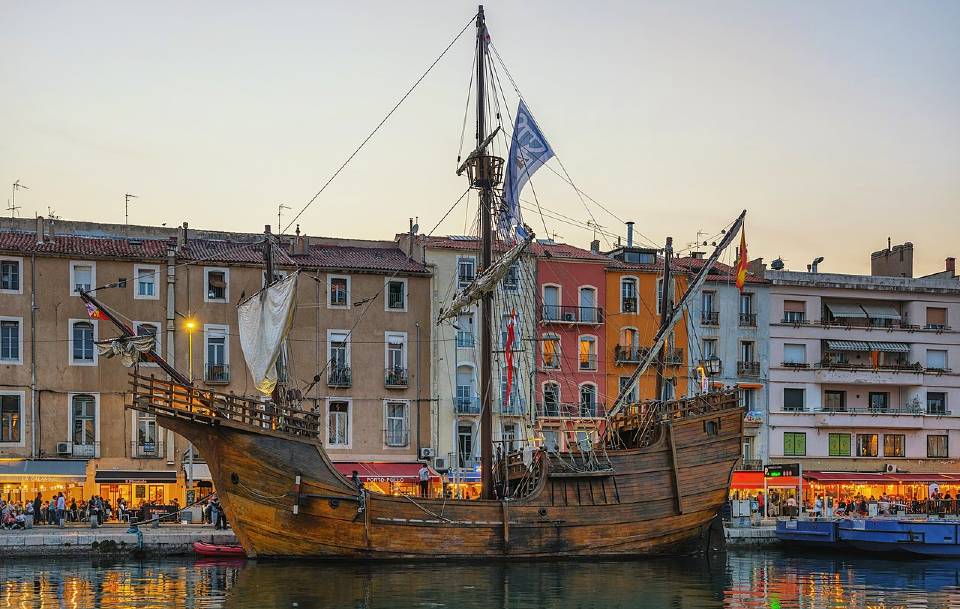
The Renaissance brought a new wave ofmaritime innovation, stimulated by the spirit of exploration at the time. Shipbuilding benefited from technical advances, with larger, sturdier ships capable of longer, safer crossings. By the 15th century, caravels were up to 30 metres long and could weigh up to 200 tonnes. The importation of the compass, invented in China, improved maps and theGreek astrolabe, perfected by the Arabs, marked a golden era for navigation.
These advances paved the way for the era of the Great Discoveries, when ships served as invaluable auxiliaries in the exploration and colonisation of new worlds, carrying passengers and equipment.
The Industrial Revolution and steamships
As with the train, the invention of steam propulsion in the 19th century marked a period of radical transformation in river and sea transport. This technological revolution began with the engineer Robert Fulton*, who invented the first commercial steam ferry line in 1807, with a boat called the Clermont linking New York to Albany over a distance of 240 kilometres via the Hudson River.
This success quickly inspired the adoption of steamships around the world, promising faster, more regular crossings that were less dependent on weather conditions. The ferry of today was born.
Steam ferries were particularly popular in Europe, where they revolutionised river and sea transport.
In England, the famous Mersey Ferry steam service began operating in 1815 on the river of the same name in the north-west of the country. It became a key element in the transport network between the cities of Liverpool and Manchester, two major economic centres.
With steam propulsion and industrial development, the design of ferries improved, making them larger, more reliable and covering longer distances. The ability to carry greater numbers of passengers, goods and vehicles opened up new economic opportunities and helped integrate more remote regions. These technical innovations are enabling a significant expansion of ferry networks, facilitating trade and population mobility on an unprecedented scale.

The 20th century: modernisation and massification
The advent of diesel-powered ferries in the 20th century marked a new era in passenger transport on rivers and seas. More efficient and reliable than steam propulsion, this new motorisation, combined with advances in naval engineering, enabled ferries to cover longer distances at higher speeds.
This period also saw the development of roll-on/roll-off (RO-RO) vessels, which facilitate the transport of vehicles and goods. This type of ferry allows cars, lorries and even trains to enter directly, making loading and unloading quicker and more straightforward.
Since then, innovations in ship design have improved thepassenger experience, with ferries offering greater comfort and better services. High-speed vessels(HSS*), which appeared in the last decades of the 20th century, further reduce crossing times, making ferries an essential link in the transport of passengers and vehicles between ports and countries.

Ferries, a vehicle for cultural and economic links
Ferries are more than just means of transport. They serve as vital links that connect countries and integrate maritime regions.
For example, in regions such as Greece and its 227 islands, these ships are essential to the local economy, facilitating trade and tourism. Similarly, in places like Istanbul, the Scandinavian countries, San Francisco or the Mediterranean islands, ferries are an integral part of cultural identity and a major tourist attraction.
Ferries also occupy a special place in popular culture, often symbolising adventure, travel and transition. They are immortalised in literature, film and music, reflecting their role in everyday life as well as in significant historical and social moments. For example, the Staten Island ferry in New York has become an iconic symbol of the city, depicted in numerous films and TV series.
Innovation and the ferries of tomorrow
Thefuture of ferries looks promising, given the importance of river and sea routes around the world. Innovations focused on sustainability (reducing pollution), energy efficiency (lowering consumption) and improving thepassenger experience (making crossings more comfortable) are constantly emerging. Advances in alternative fuel technologies, such as hydrogen and electric, as well as in ship design, promise to make ferries greener and more economical.
However, the ferry sector faces a number of challenges: environmental regulations at sea and in port, recharginginfrastructure for ships using renewable energies, and high initial costs for adopting less polluting technologies. The COVID-19 pandemic has also highlighted the importance of transport health protocols for dealing with global health crises.

Travelling by ferry?
Find the ferry for your next crossing and set off on a voyage across the waves to the destination of your choice.
Ferry by port
Looking for your departure city or destination? Choose it and leave by ferry by port:

Ferry by country
Do you have an idea for a trip? Find the ports with ferry crossings by country:
Ferry by company
Do you prefer a shipping company? Here is the list of commercial fleets for passengers:
Boat and yacht charter

Sailing or motoring, in the Mediterranean, on the oceans, rivers and canals: hire your boat easily in France, Europe and around the world with ClickandBoat.
More than 4,000 destinations and 50,000 boats available for charter directly online:

Travel+
- Robert Fulton or NGV via Wikipedia
- Maritime world portal
- The art of navigation and Renaissance ships
- How do ferries float? It’s not rocket science
- Ferry, cruise or boat in France? Book your ship (French)
- Vessels and maritime traffic in France: maps and real-time tracking (French)
- Marine and coastal maps of the Mediterranean (French)
- Boating licences in France (French)