

On the edge of the Lozère Cévennes, perched on the foothills of the Coste, lies an invisible crossroads where water hesitates between the Atlantic and the Mediterranean, a unique place where raindrops choose the Rhône, the Garonne or the Loire. Let’s set off together to discover the Laubert hydrographic tripoint, that secret point where geography becomes poetry, where every step you take takes you close to three possible travel routes.

A drop of water on the roof of France
For a moment, let us be carried away on an astonishing journey where science, landscape and imagination come together to reveal the magic of natural frontiers.
The Causse de Laubert is where the three watersheds * between the Garonne, Loire and Rhône basins meet, on their way to the Mediterranean or the Atlantic Ocean. Here, between Laubert and Montbel, on this isolated limestone plateau in Lozère, just a stone’s throw from the Pierre Plantée pass, some of the water seeps into the crozes* to feed the gourgues*, chasms and other trickles of water: the Aganit, Veyrines and Montifoulet streams, so many hydronyms that start from all sides and choose a slope.
The difference in gradient between the different rivers is striking. Heading south and north-west, the tandem peacefully makes its way towards theAtlantic Ocean from stream to stream, one via the Lot, France’s second longest river at 485 kilometres to the Garonne, the other via theAllier and its 420 kilometres to the Loire, with an artificial pause at Lake Naussac.
To the south-east, it’s a steeper climb towards the Mediterranean, via the Chassezac andArdèche rivers, which join up with the Rhône in just over 200 kilometres.
At 1241 metres above sea level, this triple point * of watershed is the highest in France, reinforcing its unique character and its nickname of the roof of France: the source of the watersheds of France’s largest river, the Loire, its most powerful, the Rhône, and Europe’s largest estuary, the Garonne.
The mystery of hydrographic tripoints
What does a hydrographic tripoint* look like?
If it were a famous place or a tourist town, it would undoubtedly be mobbed by curious visitors. But the magic of these spots lies in their discreet imagination, their humble humidity. They are places you don’t always notice, nestled in the heart of the landscape, where nature draws its invisible but tangible watersheds. In France, there are only five such watersheds.
In geography, a hydrographic tripoint is a point where the boundaries of three distinct catchment areas meet. In simple terms, it’s the point where a raindrop can choose three different paths to reach a sea or ocean.
Imagine water as a silent traveller, at the crossroads of several invisible routes sculpted by topography and natural gravity. That’s the beauty of these places: they embody a fundamental principle of hydrology and physical geography, without any exuberance.
A tripoint is therefore both simple and complex, humble and majestic. Like a secret crossroads, it is charged with a unique potential, that of sending each drop of water towards a different destiny, depending on the slope and relief, the gentle incline of the ground beneath your feet, a variant of a journey down to the last centimetre.

The Laubert tripoint, a triple birth of water
In the heart of the Massif Central, in the department of Lozère, not far from the gentle summit of the Coste, which rises to an altitude of 1,284 metres, lies this extraordinary waterway. Here, three watersheds meet, unique models of France’s great rivers, at a single, almost magical point.
These three basins correspond to the following rivers:
- The Loire
France’s longest river, at 1,066 kilometres, flows north-west from this point via the Allier to the Atlantic Ocean.
- The Garonne
It flows south-westwards, starting here at the Lot, passing through Toulouse and Bordeaux, before emptying into the Atlantic via the immense Gironde estuary.
- The Rhône
Powerful and legendary, the Rhône runs through the eastern part of the region, fed by the influx of the Ardèche, which is fed here by the Chassezac, before plunging into the Mediterranean.
Around the Col de la Pierre Plantée, each rainfall and run-off traces its own path towards these great rivers. A drop of rain falling at the tripoint can therefore, at the whim of chance, find itself bathed in different waters, and set off to encounter distinct landscapes, climates and humanities at the three cardinal points of France.
An invisible and fascinating watering hole
The Laubert tripoint is not just a geographical point, it’s a symbol, a fascinating place because it plays with our perceptions of the land and nature.
Firstly, it is extremely rare, with less than a dozen in Europe*: hydrographic tripoints are not very common, as catchment areas often have simpler boundaries, with two watersheds. This point, where precisely three major basins meet, is a pure geographical curiosity that gives this place scientific, symbolic and even philosophical value for those who stop for a moment.
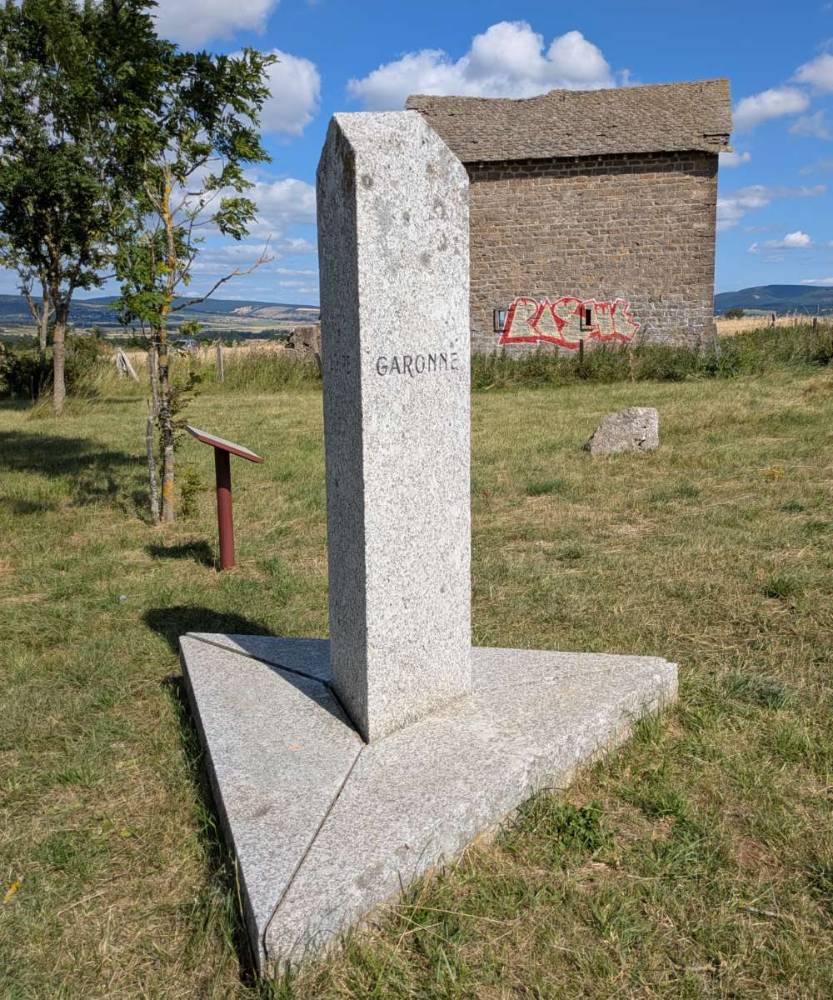
For travellers, this summit is a place to seek out, despite its location on the edge of the N88 trunk road, the view is splendid, apart from the traffic from Mende towards Le Puy-en-Velay and Aubenas, which varies according to the season. You come here to find a moment suspended in time, a magnificent landscape between agriculture and wilderness, but above all that rare sensation of being at the crossroads of three invisible worlds if you take a few steps away along the adjoining paths. Fields of wheat, others ploughed or fallow, undergrowth, an old barn with abandoned lauze roofs, a three-sided sculpted stone milestone bearing the names of rivers, a basic information panel, worn by the wind and the passage of time.

Living geography and the power of watersheds
But what exactly isa catchment area?
This is a vast area of land whose surface waters flow towards a single watercourse. Imagine a huge arena where all the streams, torrents and run-off slowly come together to form a river, which in turn plunges towards a river. The highest point of this basin marks the watershed*: beyond this point, the water takes a different path.
Around the Pierre Plantée pass on the Montbel plateau, the divide takes on a complex form: three different basins intermingle, giving rise to this exceptional tripoint. If you stand on this precise point, looking down between the sky and the ground, you can imagine yourself straddling three liquid paths, with each drop deciding its own journey down the slopes.
This physical reality reflects a strong symbolism: no territory is perfectly autonomous; interaction is permanent. Water, which must circulate in order to live, interconnects the natural regions, like a great invisible network, without any consideration for borders or other administrative divisions.
These catchment areas are also essential tools for managing water and the environment, an indispensable invisible landmark that shapes landscapes and teaches us about fundamental balances.
Map and photos of the Laubert tripoint
How can we discover the invisible so that we can better imagine it and see it in the landscape? In toponymy, maps and photos, here is the Laubert tripoint from every angle, outline and name.
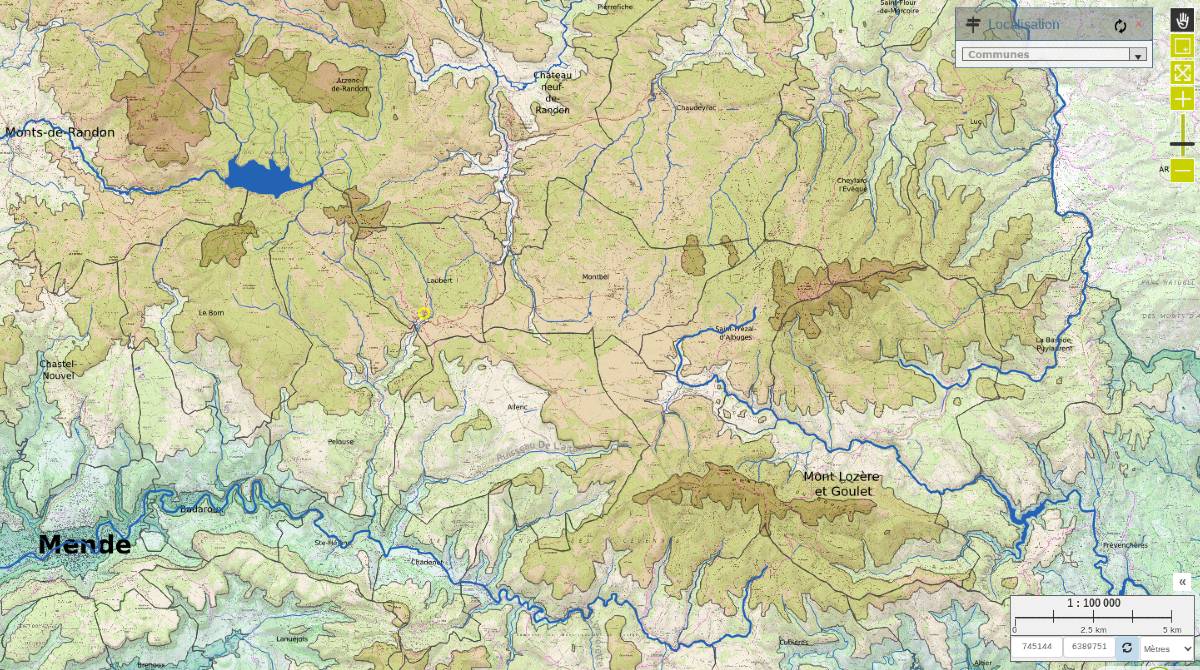
In terms of geographical location, the tripoint is on the Causse de Laubert, to the south of the locality of Pierre Plantée, the pass’s namesake, with La Mougayère to the north-west as the nearest high point, at an altitude of 1,274 metres.
A 1:25,000 scale topographical map shows the localities, streams and contour lines surrounding the point:
IGN topographic map, Géoportail
For a more precise location, here is a map showing the geographical stele, the picnic table and the abandoned house:
OpenStreetMap map, cyclOSMbackground
From an aerial view, the stele at the tripoint can be seen on the road running across the main road, between the parked vehicles and the roof of the house:

Based on the physical map of Lozère, with water layers (surface and linear), streams and rivers, and relief, the identification of the 3 catchment areas is even more visual: towards the Loire to the north-west, towards the Rhône to the south-east, towards the Garonne to the south-west:
As far as the photos are concerned, the geographical stele is very simple, with a granite base and three faces, showing the direction of the three rivers, the Loire, the Garonne and the Rhône, against a backdrop of fields, a barn with an abandoned lauze roof and the Route Nationale 88:


Discovering water’s threefold journey
The Col de la Pierre Plantée and the Laubert watershed can be explored through a number of cross-cutting themes: nature, heritage and outdoor leisure activities.
Nature
A plethora of liltingly-named streams flow around the triple point of Laubert: d’Aganit, de Malaval, de Loubière, de Palingras, des Rousses, du ravin de Veyrines… So many micro-ecosystems to discover along the footpaths and black tracks that criss-cross the region, so many trickles of water feeding one of the great rivers.
Also nearby is the Natura 2000 area of the Charpal plateau*, with the lake at its centre, originally used for military purposes, fed by numerous small streams: Combe des Ânes, Foulon del Rougio, Bouisset, Colagne, Rechauvet, Valat de l’Ermitanie, de Cros, de Grosse… like a liquid litany of hydronomy, culminating in the Charpal lake.
- A Lozère getaway to Lac de Charpal
Heritage
Around the tripoint, the Pierre Plantée and its cross, the small religious heritage is very present, with the Notre-Dame-des-Sourcesoratory, near the Aganit stream, the Prade cross and, not far away, a dolmen testifying to funerary rites in the3rd millennium BC*. Thechurch and priory of Saint-Pierre-d’Allenc, with its 11th-century chevet, is complemented by the neo-Romanesque church of Laubert, dating from the 19th century, when the commune was separated from Allenc.
Another nearby heritage feature is the Translozérienne *, which passes through Allenc station. This railway line, which was in service between 1884 and 1902, arrives in Allenc, not far from the Laubert tripoint, at an altitude of 1,050 metres, and provides connections to Langogne or Mende by train or bus from the Occitanie regional transport network, liO.
Finally, nature, with its exceptional flora and fauna, is an integral part of the area’s heritage.
Outdoor leisure activities
Hiking, mountain biking, road cycling, snowshoeing and cross-country skiing in snowy winters, fishing at Lac de Charpal, sailing at Lac de Naussac: lovers of outdoor sports and leisure activities will find plenty to satisfy their passions here.
The flora and fauna characteristic of this site, with over fifteen rare or protected plants, a diverse birdlife (quail, red and grey partridge, for example) and the presence of the European otter, also make this area unique.
Here are some simple, practical tips to help you make the most of this experience near the Laubert tripoint:
- Check the weather before and during your trip
The wind can blow hard on the Causse, the weather changes quickly in all seasons and the winter seasons are harsh and foggy.
- Bring your own supplies
Bring water and possibly a picnic to enjoy the panorama, as there are very few places to eat or buy groceries nearby.
- Take a map with you, digital or paper, it will guide you and help you read your surroundings (IGN map 2738SB, Le Bleymard )
- Take the time to find andobserve the small rivers and streams – that’s where the journey begins.
- Remember to respect nature, by not leaving any rubbish when you pass through and by following the paths and tracks: the flora is sensitive in this area with its harsh climate and the fauna must not be disturbed in its environment.

How do I get to the Col de la Pierre Plantée?
By car, train, bus, mountain bike or hike, all roads lead to the Col de la Pierre Plantée.
By car
Coming from Mende to the south-west, as you climb up to the site, the countryside changes with the Causse: forests of hooked pine, pastures, cereals that colour the open fields, rocks polished by the wind and time. Once you reach the Col de la Pierre Plantée, you’ll enjoy sweeping panoramic views, with the Massif Central on the horizon.
From Le Puy-en-Velay in the north, you need to pass through the Devès range and the plateaux of Cayres, Loudes and Landos as far as the Col de Rayol, then descend through Langogne and away from Lake Naussac, before climbing gently back up to the Col.
Finally, coming from Aubenas, after climbing up the upper Ardèche valley to the Col de la Chavade via the N102, the most bucolic route takes you along the D108 and the Espézonnette valley, a tributary of the Allier, until you reach the N88 towards Langogne.
By train
On the line between Mende and La Bastide, Allenc station is the closest to the river tripoint. Allow an hour’s walk to get there (around 6 kilometres depending on the route) and around 15 minutes by bike.
Two timetables to consult: route 30 from Mende to Montpellier and route 31 from La Bastide to Mende:

By bus
By road and bus, you can get as close as possible to the village of Laubert, at the Gourgons N88 stop with route 282, which runs between Mende in Lozère and Le Puy-en-Velay in Haute-Loire:
From the Ardèche, take the E17 line to Langogne, where you can catch the bus to Laubert or the train to Allenc :
On foot, by bike
On foot, the GR7 long-distance hiking trail from La Bastide-Puylaurent in Lozère to l’Espérou in the Gard, passing through Belvezet, is the closest.
By mountain bike, the Grande Traversée du Massif Central (GTMC) takes you directly to the site: from the Baraque des Bouviers section at Bagnols-les-Bains or the Liaison de Langogne à Laubert link.
By bike, between Mont Lozère and the Goulet mountain, the Causse de Montbel loop takes you as close as possible to this beautiful circuit.

The weather in Laubert
And for your trip there or far away, here is the weather forecast for the communes of Laubert (48170) :
Where to sleep?
Allenc, close to the SNCF station, Chateauneuf-de-Randon, Saint-Frézal-d’Albuges, Mende or Langogne before connecting by bus or train: there is a wide range of accommodation on offer, so it’s up to you to organise your stay to suit your journey:
Meet at the Laubert tripoint
At the Pierre Plantée pass, near Allenc and Laubert, every drop of water is a promise. A promise of adventure, of a journey, of an encounter with distant worlds linked by a simple natural movement. A journey that begins in the silence of a Causse and ends with the force of a river.
This hydrographic tripoint is an invitation to reconsider the way we look at the landscape. It’s not just a line on a map or an altitude on a curve, it’s a doorway to understanding our planet and marvelling at its mysteries.
More broadly, these rare spots are jewels in France’s and Europe’s natural heritage. They tell us about the complexity, fragility and beauty of the Earth. They are a reminder that water, the source of life, is also a universal bond.
So the next time the rain caresses you, think of this drop that fell just beside the Pierre Plantée in Laubert.
Where will it choose to travel? Which liquid path will it take?
The answer lies with water, restless and free, mistress of invisible crossroads.
Travel+
- Watershed
As a reminder, the watershed is a geographical boundary that divides an area into one or more catchment areas. On either side of this line, water flows in different directions, towards a different river, sea or ocean. - WorldHydrographic Tripoint, Wikipedia
- Crozes?“Hollow. Having a cavity, an inner hole“. Wiktionary
- Gourgue?“Abyss where water remains when the stream is dry in the hot season“. Paul Fabre, Persée
- In chemistry, the triple point is also a phase in which three states coexist: liquid, solid and gas.
- The Plateau de Charpal Natura2000 site
- History of the village of Allenc
- Translozérienne, from Monastier to Bastide-Saint-Laurent-les-Bains, Wikipedia
- List and map of communes in Lozère