
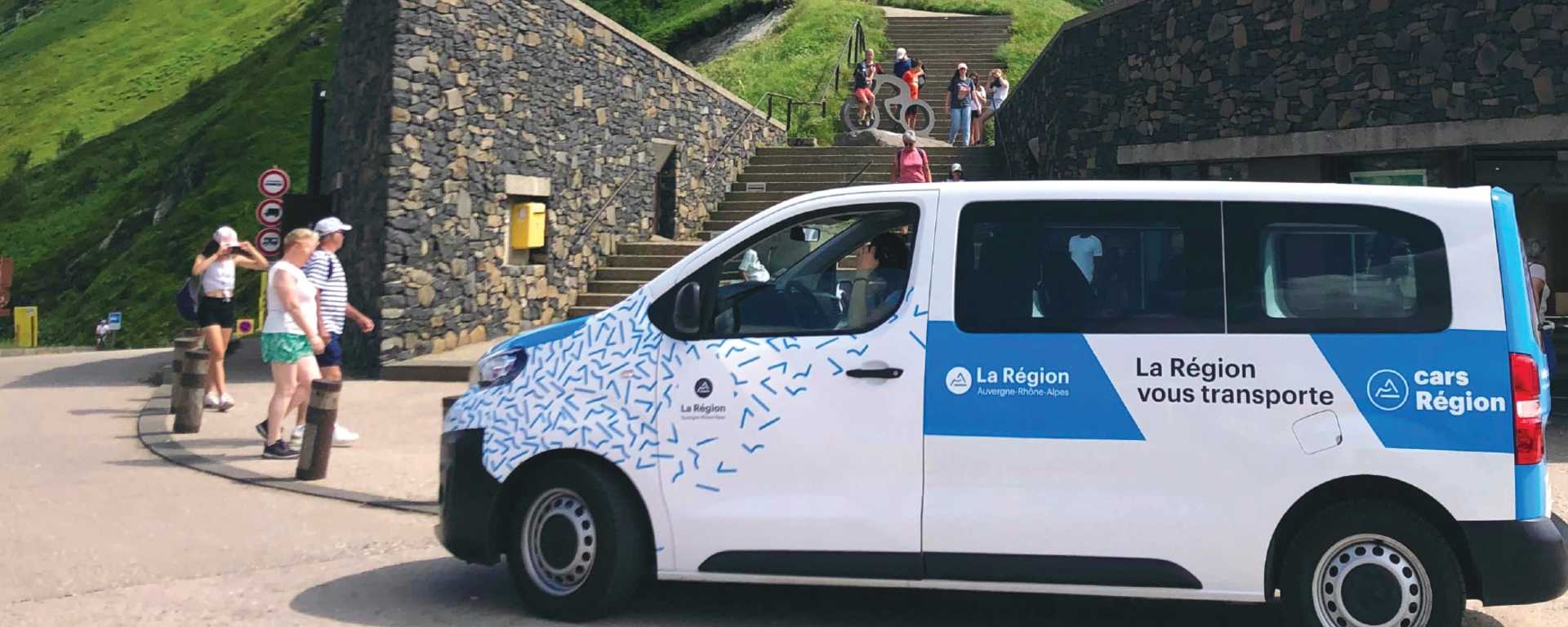
Every summer, the ‘Lignes du Volcan’ service takes you to the Puy-Mary volcano in the Cantal, a ‘Grand Site de France’. On this page, you can find practical information on thetimetables and stopsfor the shuttle bus to the peaks.

The Volcano’s Contours
The departmental bus and coach network, managed by the Auvergne-Rhône-Alpes Region, offers bus routes throughout the Cantal department, as well as to the Puy-de-Dôme, the Lot and the Corrèze. The ‘Cantal Volcano’ routes will take you on your journeys throughoutthe summer to the Puy Mary volcanic site and the Cantal Mountains.
These bus routes will take you from the four corners of the Cantal region to its volcanoes. There are eight bus routes, accessible via connections, to Puy Mary and the many walking trails around the Cantal volcanoes along the GR400.
You can get a lift from Aurillac, Clermont-Ferrand, Murat, Vic-sur-Cère, Le-Lioran and on routes C02 and C08 of the departmental bus network.
Connecting services are available, subject to timetables:
➡ Auvergne-Rhône-Alpes departmental and regional buses, TER trains,long-distance coachesorcar hire.
Puy-Mary buses: the Volcan routes
For the summer season, the routes to Puy Mary are as follows:
- Route 1: Mandailles-Saint-Julien, Puy-Mary, Col de Serre
- Route 2: Le Falgoux, Puy Mary, Col de Serre
- Line 3: Rioms-ès-Montagne, Pas de Peyrol – Puy Mary
- Route 4 : Saint-Martin-de-Valmeroux, Salers, Col de Neronne, Le Falgoux
- Route 5: Le-Lioran, Murat, Col-de-Serre
- Line 6: Vic-sur-Sère, Col du Pertus, Mandailles-Saint-Julien
- Line 7: Vic-sur-Sère, Pailherols
- Line 8: Le Claux, Pas de Peyrol – Puy Mary
Departmental roads
Bus routes with connections operating all year round:
- Bus route C02: Mauriac / Aurillac (formerly route LR102)
- Bus route C08: Riom-es-Montagnes / Clermont-Ferrand (formerly route LR108)
- Other bus routes in the Cantal
Timetables and stops
Check thetimetablesandstopsfor the Volcan routes to Puy Mary in the Cantal:

Reader, instructions for use (French)
Route maps and exploring volcanoes
Find a ticket or a connection

Map of the Volcan bus routes
Bus routes to Puy Mary and around the Monts du Cantal, shown on maps to help you explore the area and choose your destination.
Discovery Card
Discovery map of the Puy Mary – Volcan du Cantal ‘Grand Site de France’:
Correspondence
Departmental bus routes operating all year round:
- Bus route C02: Mauriac / Aurillac (formerly route LR102)
- Bus route C08: Riom-es-Montagnes / Clermont-Ferrand (formerly route LR108)
Interactive map of the routes
The volcano’s contours, in an interactive version:
GR400, the Cantal Volcanoes Circuit
And for your hikes, here is the route of the GR400, the Cantal Volcanoes Trail:
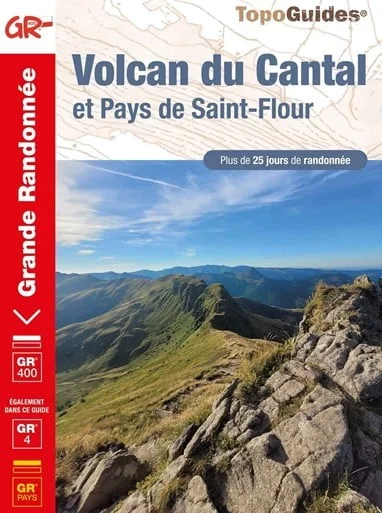
TopoGuides: The Volcanoes of Cantal and the Saint-Flour Region
The Cantal Volcano and the Saint-Flour Region
The Cantal Massif is a wonderful playground for lovers of wide open natural spaces, spanning a diameter of around 70 kilometres.
It is one of the most significant volcanic regions in Europe, notably featuring the Plomb du Cantal and the Puy Mary.
Peaks, mountains and plateaus have gradually taken the place of the enormous volcano that once stood there.
Hikers walk at altitudes ranging from 750 to 1,855 metres, taking in breathtaking scenery.
From Plomb du Cantal or Puy Mary, you’ll get a real sense of this almost mountainous region, which has become a vast high-altitude pasture.
To the east of this route lies Saint-Flour, a ‘Land of Art and History’ and a Cluniac site, nestled at the foot of the Margueride mountains.
Perched on its basalt promontory, Saint-Flour, through its bishop’s palace and cathedral, jealously guards the memory of its former prosperity. It is the gateway to the flattened peaks of the Margeride, dotted with granite boulders, to the Truyère Gorges and to the vast basalt plateau of the Planèze.
The Cantal Volcano and the Saint-Flour Region – GR®400
Available at your favourite bookshop or online:



Mount Puy Mary as seen from France
From regions across France to Puy Mary? A simplified map showing journey times:

Travel+
- Puy Mary, official website and Wikipedia
- The Causses Line, the Cévénol Line